Sourdough Dinner Rolls with Rosemary and Sea Salt
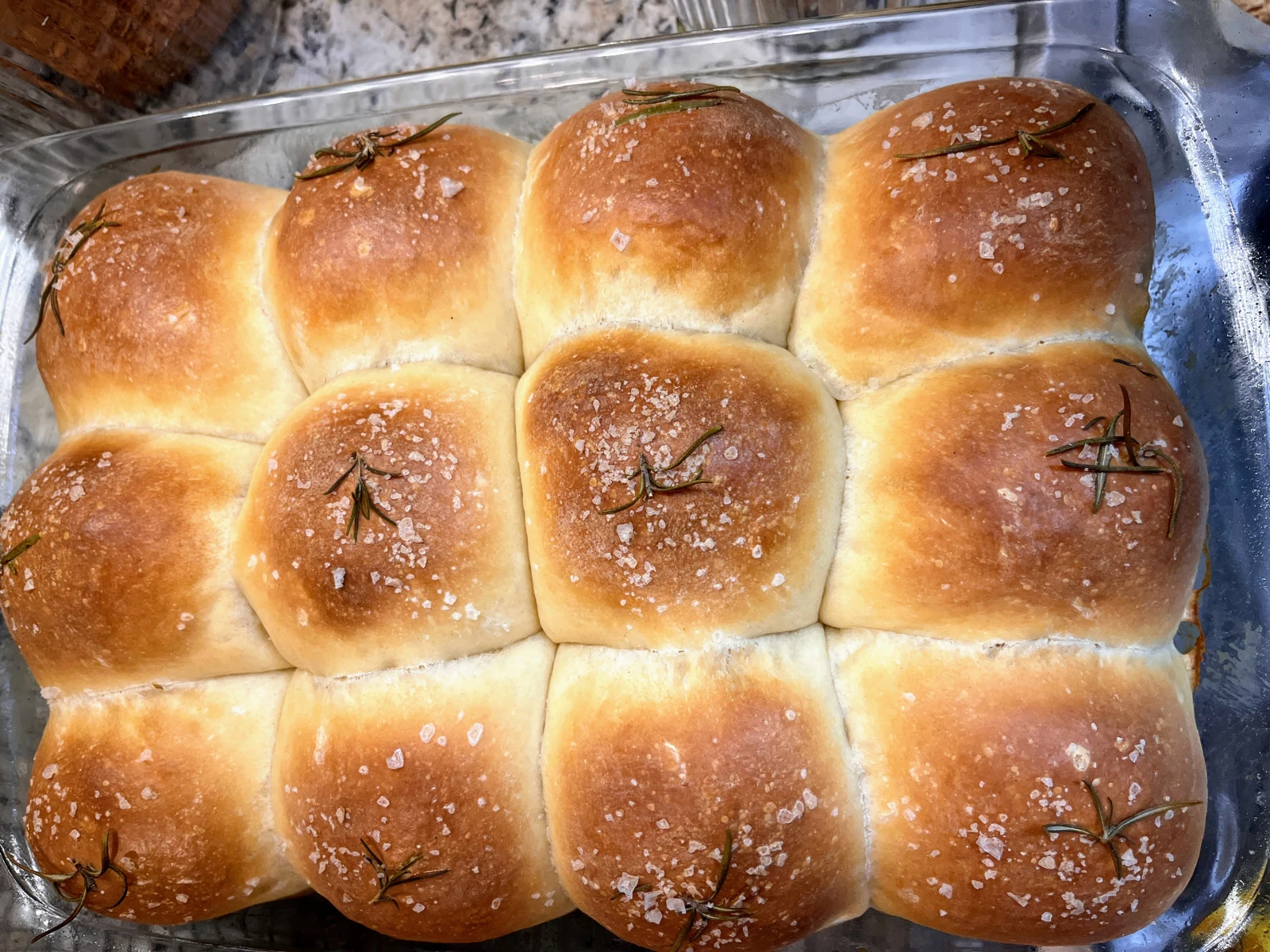
Soft Pull-Apart Rolls, Naturally Leavened
Soft sourdough dinner rolls with fresh rosemary and flaky sea salt. A sweet levain keeps them mild, and an overnight option fits the holiday schedule.
By Henry Hunter Jr., founder of Crust & Crumb Academy and Baking Great Bread at Home.
- Prep
- 40 minutes
- Rise
- 18 to 20 hours, including the overnight levain
- Bake
- 25-30 minutes
- Total
- About 20 hours, mostly hands-off
- Yield
- 12 large dinner rolls, about 88 g of dough each
- Difficulty
- intermediate
- Hydration
- 70%
Ingredients
Sweet Levain
Build the night before, 10 to 12 hours ahead
- 20g (1 tbsp + 1 tsp) ripe sourdough starter, 100% hydration
- 75g (1/2 cup + 2 tbsp) all-purpose flour
- 75g (5 tbsp) water, room temperature
- 15g (1 tbsp) granulated sugar
Dough
Same flour, liquid, butter, sugar, egg, and salt as the yeasted rolls, with the levain's share taken out
- 185g (3/4 cup (approx.)) all of the sweet levain
- 245g (1 cup) whole milk, warmed to 85-90°F (29-32°C)
- 35g (2 tbsp + 1 tsp) water, room temperature
- 57g (4 tbsp (1/4 cup)) unsalted butter, melted and cooled
- 35g (3 tbsp) granulated sugar
- 50g (1 large) large egg, room temperature
- 440g (3 1/2 cups) all-purpose flour
- 9g (1 1/2 tsp) kosher salt
- 5g (1 tsp) neutral oil for greasing
Toppings
- 50g (1 large) large egg, beaten (for wash)
- 12 sprigs (12 sprigs) fresh rosemary sprigs (2-3 inches)
- 2g (1/2 tsp) Maldon sea salt (or flaky salt)
- 40g (3 tbsp) unsalted butter, melted (for brushing)
Total flour: 525g
Hydration: 70%
Pro tip: Your starter does all the lifting here, so use it at its peak. A sluggish starter in a dough with milk, butter, egg, and sugar rises slowly and turns sour before it turns light.
Equipment
- Stand mixer with dough hook (or large bowl for hand mixing)
- Baking sheet (13x18 inch)
- Digital kitchen scale
- Instant-read thermometer
- Small jar or bowl for the levain
- Pastry brush
- Clean kitchen towel
Method
Build the Sweet Levain (The night before)
A little sugar in the levain keeps the rolls mild instead of tangy.
- Mix the levain. In a small jar, stir together the ripe starter, flour, water, and sugar until no dry flour is left. Cover loosely.
- Let it ripen. Leave the levain at about 75°F (24°C) for 10 to 12 hours. It's ready when it has at least doubled, the top is domed and full of bubbles, and it smells sweet and yeasty, not sharp.
Wait: PT11H
Tip: Mix it around 9 PM and it's ready to use around 8 the next morning.
Mix the Dough (Next morning, about 5 minutes)
No yeast to bloom, so the milk only needs to be warm, not hot.
- Warm the milk. Warm the milk to 85-90°F (29-32°C). Hotter than that and you risk cooking the levain. Let the melted butter cool until it's barely warm.
- Combine the wet ingredients. In a stand mixer bowl or large bowl, combine the warm milk, water, cooled butter, sugar, egg, and all of the levain. Stir until the levain breaks up and the mixture looks even.
- Add the flour and salt. Whisk the flour and salt together, add them to the bowl, and mix on low speed (or by hand) for 2 to 3 minutes until the dough comes together. It will look rough and sticky.
Knead the Dough (8 to 10 minutes)
A long sourdough rise needs strong gluten to hold it.
- Stand mixer method. Increase to medium speed and knead 8 to 10 minutes, until the dough pulls away from the sides and forms a smooth ball. It should be soft and tacky. If it's still sticking to the sides after 6 minutes, add flour 1 tablespoon at a time, up to 2 tablespoons.
- Hand kneading method. Turn onto a lightly floured surface and knead about 10 minutes. The dough should be soft and tacky but not sticky.
- Windowpane test. Stretch a small piece thin enough to see light through without tearing. That's the windowpane test. If it tears, knead 2 more minutes and check again. Aim for a finished dough temperature around 78°F (26°C).
Bulk Fermentation (4 to 5 hours)
This is where sourdough asks for patience. The yeasted version takes an hour. This takes most of the morning.
- Prepare the bowl. Oil a large bowl. Place the dough in the bowl, turn to coat, and cover.
- Fold twice. Keep the dough in a warm spot, 76-78°F (24-26°C). Give it one set of stretch and folds at 45 minutes and another at 90 minutes, then leave it alone.
- Judge the rise. Bulk fermentation is done when the dough has grown by about 75%, the surface is domed and smooth, and it feels light and airy when you jiggle the bowl. Not doubled. That usually takes 4 to 5 hours at this temperature.
Wait: PT4H30M
Tip: Watch the dough, not the clock. In a 70°F (21°C) kitchen this can run 6 to 7 hours. Use the oven with only the light on if your kitchen runs cool.
Shape the Rolls (About 10 minutes)
Divide and shape into round rolls.
- Turn out the dough. Turn the dough onto a clean surface with no flour and press it down gently. If it's too soft to handle, chill the covered bowl for 20 minutes first.
- Divide evenly. Divide into 12 equal pieces, about 88 g each.
- Shape rolls. Cup your hand over each piece and move in circles with slight pressure to form a tight ball. Place seam-side down on a greased or parchment-lined baking sheet.
- Space appropriately. Space rolls 1.5 inches apart for soft sides that touch, or 3 inches apart for crispy sides.
Final Proof (2 to 3 hours, or overnight in the fridge)
Pick the path that fits your day.
- Same-day proof. Cover with a towel and let the rolls rise at 76-78°F (24-26°C) for 2 to 3 hours, until puffy and almost doubled. When pressed gently, the dough should spring back slowly.
- Overnight option. Cover the pan tightly and refrigerate 8 to 14 hours. The next day, set the pan out at room temperature for 2 to 4 hours, until the rolls are puffy and spring back slowly, then bake.
Wait: PT2H30M
Tip: Under-proofed sourdough rolls bake up dense. If you see a tight, heavy roll with no jiggle, give it another 20 to 30 minutes.
Shaping
Round, evenly sized dinner rolls.
Classic Round Rolls (recommended)
Traditional dinner roll shape with soft, touching sides.
- Divide. Divide into 12 equal pieces, about 88 g each.
- Round. Cup your hand over each piece and move in circles with slight pressure to form a tight ball.
- Pan. Place seam-side down on the baking sheet, spacing 1.5 inches apart for soft sides.
Proof test: Press gently with a floured finger. The dent should spring back slowly and only partway.
Baking
Bake until deep golden brown, with the rosemary and salt on top.
Oven: 190°C / 375°F. Internal temperature when done: 88-91°C / 190-195°F.
Standard Oven (Recommended) (recommended)
Bake until deep golden brown and the internal temperature reaches 190-195°F (88-91°C).
Equipment: Baking sheet, parchment paper, oven
- Preheat. Heat the oven to 375°F (190°C) about 20 minutes before the rolls finish proofing.
- Apply egg wash. Brush the rolls gently with beaten egg. Don't deflate them, and don't let egg pool between the rolls.
- Add toppings. Press one rosemary sprig into the top of each roll and sprinkle with Maldon salt.
- Bake. Bake 25 to 30 minutes, until deep golden brown and 190-195°F (88-91°C) inside. If the tops brown too fast, tent with foil for the last 10 minutes.
- Finish. Brush with melted butter as soon as they come out. Cool 5 minutes and serve warm.
Note: Brush with melted butter the minute they come out of the oven. That's where the shine comes from.
Storage
- Room temperature: Store in an airtight container at room temperature for 2 to 3 days. Reheat wrapped in foil at 300°F (150°C) for 10 minutes.
- Refrigerated: Not recommended. The fridge stales bread faster.
- Frozen: Wrap cooled rolls individually and freeze up to 3 months. Reheat from frozen at 350°F (175°C) for 10 to 12 minutes.
For same-day serving, keep the rolls covered with a towel until you're ready to eat so they stay soft.
Frequently Asked Questions
Will these taste sour?
Mildly, if at all. The sugar in the levain and a warm, steady rise keep the tang in the background. A long, cool rise or an overripe levain will bring more sourness.
Can I use my starter straight from the jar instead of building a levain?
Yes, if it's at its peak. Use 170 g of ripe, bubbly 100% hydration starter and put all 50 g of sugar in the dough. Expect a little more tang than the sweet levain gives you.
My kitchen is cold. Will the dough still rise?
Yes, it just takes longer. Put the bowl in the oven with only the light on, and go by how the dough looks and feels, not the time.
Why are my rolls dense?
Usually a tired starter or a short proof. Use the levain at its peak, knead to a full windowpane, and let the shaped rolls get properly puffy before they go in the oven.
Can I shape them the night before?
Yes. Shape, cover the pan tightly, and refrigerate 8 to 14 hours. The next day, let them sit out 2 to 4 hours until puffy, then bake.
Can I add a little yeast for insurance?
You can. Add 1 g (1/4 teaspoon) of instant yeast with the flour. It shortens both rises, so start checking the dough early.
Is there a dairy-free option?
Use warmed almond or oat milk, and vegan butter or olive oil in place of the butter.
What if I'd rather make the yeasted version?
The Ultimate Dinner Rolls with Rosemary and Sea Salt use the same toppings and bake the same way, and they're done in about two and a half hours.
Nutrition
Per serving (1 roll): 250 calories, 38g carbohydrates, 6g protein, 8g fat, 1g fiber, 360mg sodium. Makes 12 servings.