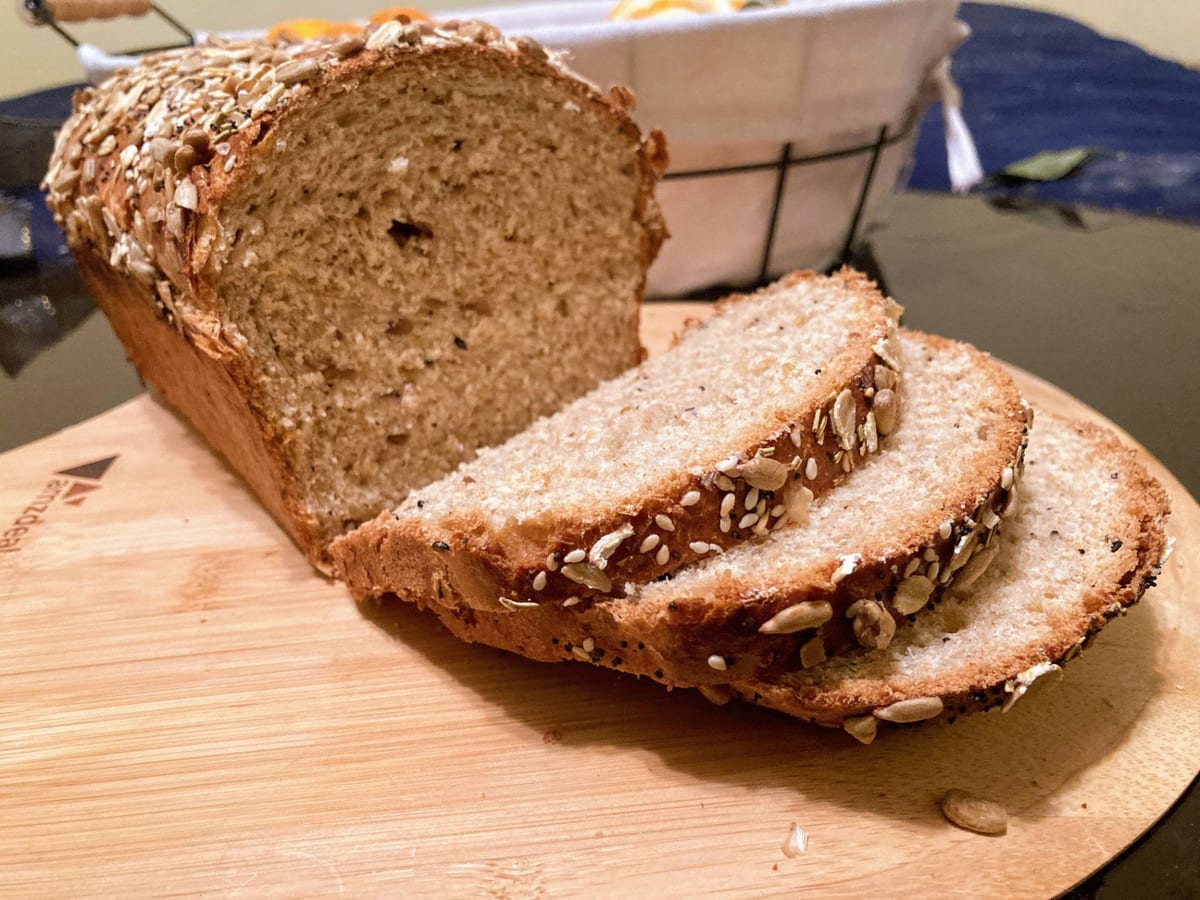
Soft Multigrain Sandwich Bread
The Scald Method for a Pillowy Crumb with Real Grain in It
YieldOne 9 by 5 inch loaf, about 16 slices
Prep35 minutes
Bake35 to 40 minutes
Difficultyintermediate
Ingredients
The Scald (2 Hours Ahead, or the Night Before)
- 60g seven grain hot cereal, ground fine • ⅓ cup
- 40g bread flour • ⅓ cup
- 200g boiling water • ¾ cup plus 2 tablespoons
- 1g fine sea salt • ⅛ teaspoon
The Dough
- 360g bread flour • 3 cups
- 50g whole wheat flour • ⅓ cup plus 2 tablespoons
- 180g whole milk, lukewarm (about 95F / 35C) • ¾ cup
- 20g nonfat dry milk powder • ¼ cup plus 1 tablespoon
- 45g honey • 2 tablespoons
- 40g unsalted butter, softened • 2¾ tablespoons
- 8g fine sea salt • 1¼ teaspoons
- 6g instant yeast • 2 teaspoons
The Top
- 10g whole milk, for brushing • 2 teaspoons
- 12g old-fashioned rolled oats • 2 tablespoons plus 1 teaspoon
Method
- Put the seven grain cereal in a spice grinder, coffee grinder, or dry blender and pulse for about 30 seconds, until it looks like coarse cornmeal. A few larger pieces are fine. You're not making flour, just breaking the grain down so the hot water can reach inside it.
- Whisk the ground cereal, the 40g of bread flour, and the salt together in a medium heatproof bowl. Mixing them dry first keeps the flour from clumping when the water hits it.
- Pour the boiling water over the mixture all at once and whisk immediately and hard for about a minute. It will thicken under the whisk into a smooth, glossy paste about the consistency of thick oatmeal. Lumps here become lumps in the loaf, so keep whisking until it's smooth.
- Press plastic wrap directly onto the surface so a skin doesn't form, then let it cool to room temperature. Two hours on the counter, or make it the night before and refrigerate it. If it's cold from the fridge, let it sit out for 30 minutes before mixing.
- In the mixer bowl, add both flours, the milk, dry milk powder, honey, salt, yeast, and the whole cooled scald. Mix on low with the dough hook for 2 minutes until no dry flour remains. The dough will look pasty and slightly odd at this stage. It comes around.
- Cover and rest. A short autolyse gives the whole wheat time to soften and lets the scald finish distributing itself through the dough.
- Add the softened butter in three or four pieces with the mixer on low. It will look like the dough is separating. Keep the mixer running and it pulls back together within two minutes.
- Mix on medium-low for 9 to 11 minutes. This dough needs more development than the others in the series, because the scald has already given up some of its protein and the rest has to carry the loaf. Check the windowpane-test: you want a thin, even, translucent film that doesn't tear. Keep going until you get it.
- Mix until shaggy, rest 20 minutes, work the butter in with your fingers, then slap-and-fold on the counter for 12 to 14 minutes with three rests of 5 minutes in the middle. The rests do a lot of the work, and this dough is soft enough that hand mixing is genuinely pleasant.
- Shape the dough into a smooth ball, drop it into a lightly oiled container, and cover it. Mark the starting height.
- Rise at room temperature for 1¼ hours, until the dough has genuinely doubled. Unlike the whole grain loaves in this series, this one can and should double, because there's little grain interrupting the gluten and plenty of structure to spare.
- Turn the dough out onto a lightly floured counter and press it flat with your palms to push the big bubbles out. Pat it into a rectangle as long as your pan and about ¾ inch thick.
- Roll it up snugly from the short edge, pinching the seam closed as you go. This dough rolls beautifully and holds its shape, so use that and roll firmly.
- Seam side down in a greased 9 by 5 pan, pressed gently into the corners so it rises level from end to end.
- Cover loosely and proof 50 to 70 minutes, until the crown of the dough sits 1 to 1½ inches above the rim of the pan.
- Use the poke-test. A floured fingertip should leave a dent that fills back in slowly and stops just short of level. This dough is soft, so press gently and read carefully.
- Brush the top with milk, not water, then scatter the rolled oats over it. The milk sugars and proteins glue the oats down as the loaf bakes so they don't end up all over your counter.
- Bake at 350F (175C) on the lower-middle rack for 35 to 40 minutes. Rotate the pan front to back at the 20 minute mark.
- Milk powder browns faster than anything else in this loaf. Expect to tent it loosely with foil around the 22 minute mark, and don't take deep color as a sign it's finished.
- Done is 195F to 200F (90C to 93C) in the center. A scald loaf is the easiest bread in this series to underbake, because the gelatinized starch holds so much water that the crumb reads soft even when it's still wet.
- Out of the pan immediately onto a wire rack. Wait at least 2 hours before slicing. I know it's soft and warm and smells like the best idea you've had all week. Wait anyway.
- Brush the crust with a little butter as soon as it comes out of the pan. On this loaf that's not optional if soft is what you're after. It keeps the top crust tender instead of leathery.