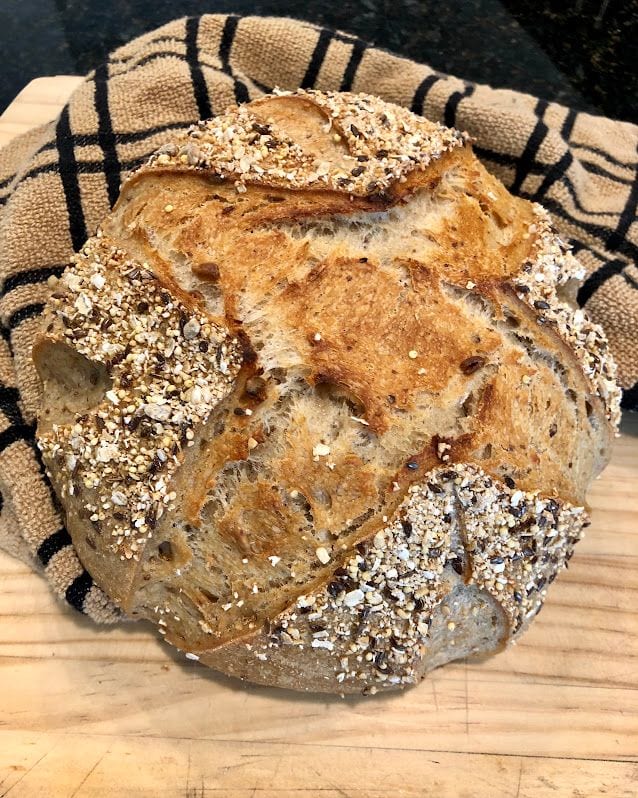
Rustic Multigrain Country Loaf
A Dutch Oven Boule with Cracked Wheat, Rye, Flax, and Sunflower
YieldOne 1400g boule, about 16 thick slices
Prep45 minutes
Bake45 to 50 minutes
Difficultyintermediate
Ingredients
The Poolish (Night Before)
- 180g bread flour • 1½ cups
- 180g water (about 70F / 21C) • ¾ cup plus 1 tablespoon
- 0.4g instant yeast • ⅛ teaspoon
The Hot Soaker (Night Before)
- 60g cracked wheat or medium bulgur • ⅓ cup plus 1 tablespoon
- 135g boiling water • ½ cup plus 1½ tablespoons
- 1.5g fine sea salt • ¼ teaspoon
The Cold Soaker (Night Before)
- 30g whole flaxseed • 3 tablespoons
- 45g raw sunflower seeds • ⅓ cup
- 75g cool water • ⅓ cup
The Final Dough
- 240g bread flour • 2 cups
- 120g whole wheat flour • 1 cup plus 1 tablespoon
- 60g dark rye flour • ½ cup plus 1 tablespoon
- 270g water (about 85F / 29C) • 1 cup plus 3½ tablespoons
- 11g fine sea salt • 1¾ teaspoons
- 2.5g instant yeast • ¾ teaspoon
The Crust
- 30g mixed seeds for coating, sunflower and sesame • 3½ tablespoons
Method
- Whisk the flour, water, and the tiny amount of yeast together until it looks like thick pancake batter with no lumps.
- Cover loosely and leave it at room temperature for 12 to 14 hours. It's ready when the surface is domed and bubbled and just beginning to sink in the middle. That slight collapse is the signal, not a problem.
- Put the cracked wheat and salt in a heatproof bowl and pour the boiling water over it. Stir well, cover, and leave it on the counter overnight. It should absorb nearly all the water and swell to about three times its dry volume.
- In a second bowl, stir the flaxseed and sunflower seeds into the cool water. Cover and leave it out overnight. The flax will turn the water into a loose gel. That gel is supposed to happen and it goes into the dough with the seeds.
- In a large bowl, mix the bread flour, whole wheat, rye, water, the whole poolish, and the whole hot soaker until there's no dry flour anywhere. Skip the salt, the yeast, and the seeds for now. The dough will be sticky and shapeless.
- Cover and rest. This autolyse is where the whole wheat and rye bran soften and the gluten starts organizing itself with no work from you. Forty minutes here saves you ten minutes of kneading later.
- Sprinkle the salt and yeast over the dough and work them in by pinching and folding for about 2 minutes, until you can't feel any grit. The dough will tighten up as the salt goes to work.
- Thirty minutes after the salt goes in, wet your hand and give it a set of stretch-and-fold. Lift one side up and over the center, turn the bowl a quarter, repeat four times. The dough will feel loose. That's normal at this stage.
- Thirty minutes later, pour the whole seed soaker, gel and all, right on top of the dough. Fold the dough over it. It will feel like the gel is sliding around and refusing to mix in. Leave it. Do not force it or knead it in, because that shears the gluten you just built.
- Thirty minutes after that, fold again. By now the seeds will be evenly distributed and the gel will have disappeared into the dough. This is where the dough finally starts holding a shape and feeling strong.
- Cover and leave it alone for another 1½ to 2 hours. Total bulk runs 3 to 4 hours at 76F to 78F (24C to 26C). Look for the dough to grow by about 70%, feel puffy and alive, and show a jiggle when you shake the container.
- Turn the dough out onto a lightly floured counter. Using a bench scraper and one wet hand, pull the edges into the center to make a loose round. Leave it uncovered for 20 to 30 minutes to relax.
- Flip the round over. Fold the bottom third up, the sides in, then roll it away from you into a tight ball, using the counter's friction to build tension across the top. Cup your hands around the base and drag it in a small circle to seal the bottom.
- If you're doing a seed crust, mist the top with water and roll the loaf through the mixed seeds. Set it seam side up in a floured banneton or a towel-lined bowl.
- Cover and proof at room temperature for 45 to 60 minutes, until the loaf has grown by about half and feels airy when you press it. Bake as soon as it gets there.
- Cover the basket and refrigerate for 10 to 14 hours, then bake straight from cold. This is the version I'd pick. The dough firms up, the flavor gets deeper, and a chilled skin takes a scoring cut cleanly instead of dragging.
- Use the poke-test. Press the side gently with a floured finger. The dent should come back slowly and not quite all the way. Cold dough always reads firmer than it is, so with the overnight version trust the volume more than the poke.
- Put the Dutch oven with its lid on into a cold oven and heat to 480F (250C). Give it a full 45 minutes at temperature.
- Turn the loaf out onto parchment, seam side down. Score it with a confident stroke about ½ inch deep, either one long curve or a simple cross. Lift the parchment and lower the whole thing into the hot pot. Lid on.
- Drop the oven to 450F (230C) and bake covered for 22 minutes. Don't peek. All the steam you need is coming out of the dough and staying under that lid.
- Pull the lid and bake another 22 to 27 minutes until the crust is deep brown and the seeds on top have toasted. A pale crust means an underdeveloped flavor, so let it go darker than feels comfortable.
- Done is 205F to 210F (96C to 99C) in the center. A grain loaf this wet needs the top of that range. Pulling it at 200F leaves you with a damp center.
- Onto a wire rack, and leave it alone for at least 3 hours. Cutting into a hot high-hydration loaf gives you a gummy, pasty crumb, and it's not the recipe's fault. Four hours is better.