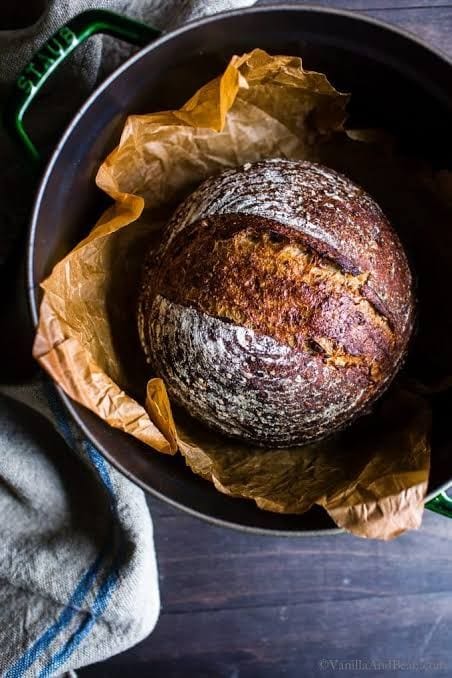
Four Grain Soaker Pan Bread
Steel-Cut Oats, Polenta, Millet, and Flax in One Straight-Dough Loaf
YieldOne 9 by 5 inch loaf, about 16 slices
Prep35 minutes
Bake40 to 45 minutes
Difficultyintermediate
Ingredients
The Hot Soaker
- 35g steel-cut oats • 3 tablespoons
- 25g coarse cornmeal or polenta • 2 tablespoons plus 1 teaspoon
- 20g millet, hulled and raw • 1 tablespoon plus 2 teaspoons
- 10g whole flaxseed • 1 tablespoon
- 140g boiling water • ½ cup plus 2 tablespoons
- 1g fine sea salt • ⅛ teaspoon
The Dough
- 340g bread flour • 2¾ cups plus 1 tablespoon
- 110g whole wheat flour • 1 cup
- 250g water (about 95F / 35C) • 1 cup plus 2 tablespoons
- 35g honey • 1 tablespoon plus 2 teaspoons
- 20g olive oil • 1½ tablespoons
- 8g fine sea salt • 1¼ teaspoons
- 5g instant yeast • 1½ teaspoons
The Top
- 10g water, for brushing • 2 teaspoons
- 10g old-fashioned rolled oats • 2 tablespoons
- 5g millet, raw, for the top • 1¼ teaspoons
Method
- Put the steel-cut oats, cornmeal, millet, flaxseed, and salt in a medium heatproof bowl and stir them together dry so they're evenly mixed.
- Pour the boiling water over the top and stir hard for 20 or 30 seconds. Cornmeal clumps if you're gentle with it, and a clump of dry cornmeal in the middle of your loaf is unpleasant to bite into.
- Cover and leave it on the counter at least 1 hour, until it's no warmer than lukewarm. Overnight is better if you have the time. It should look like a loose, glossy porridge with visible whole millet grains sitting in it.
- In a large bowl, stir together both flours, the water, honey, olive oil, salt, yeast, and the whole cooled soaker. Use a dough whisk or a sturdy spoon and mix until there's no dry flour left. It'll be a shaggy, sticky, unpromising mess.
- Cover the bowl and walk away. The autolyse lets the whole wheat bran soften and the flour finish drinking, and it makes the next step dramatically easier. Come back and the dough will already look like dough.
- Turn the dough out onto an unfloured counter and slap-and-fold for 3 minutes. Pick up one end, slap it down, fold it over itself, turn 90 degrees, repeat. It'll be sticky for the first minute and then start pulling itself together.
- Cover it with the bowl and leave it. The gluten relaxes and reorganizes on its own during this rest, which is why the second round goes so much faster than the first.
- Slap and fold another 3 minutes. Now the dough should be smooth, elastic, and tacky rather than sticky. Check the windowpane-test: pull a piece thin enough to see light through. The millet and oats will interrupt the window, so look at the film between the grains, not through the grains themselves.
- Instead of the two rounds above, mix on medium-low with the dough hook for 6 to 8 minutes after the rest. Watch for the dough to clear the sides of the bowl and pull cleanly away from your finger.
- Shape the dough into a ball, put it in a lightly oiled bowl or straight-sided container, and cover it.
- Give it a single set of folds at the 45 minute mark. Wet your hand, lift one side over the center, turn the bowl, repeat four times. This one set noticeably improves the crumb and costs you 30 seconds.
- Cover and rise another 45 minutes to an hour, until the dough has grown by about three quarters and feels light when you lift the container. Total bulk runs about 1½ hours at 76F to 78F (24C to 26C).
- Turn the dough onto a lightly floured counter and pat it into a rectangle about 9 inches wide, matching the length of your pan, and roughly ¾ inch thick.
- Roll it up tightly from the short edge, pinching the seam closed with your thumbs as you go. Press firmly enough to feel any air pockets pop under your hands.
- Set it seam side down in a greased 9 by 5 pan and press it gently into the corners so the loaf rises evenly from end to end.
- Cover loosely and proof 50 to 65 minutes, until the center of the loaf sits about 1 inch above the rim of the pan.
- Use the poke-test. A floured fingertip pressed into the side should leave a dent that fills back slowly and stops just shy of level. Fast spring back means wait. A dent that stays put means bake it now.
- Brush the top gently with water, then scatter the rolled oats and raw millet over it. Brush light. A fully proofed loaf deflates under pressure.
- Bake at 375F (190C) on the lower-middle rack for 40 to 45 minutes. Turn the pan front to back at the 25 minute mark.
- The millet and oats on top toast fast. If they're getting dark before 25 minutes, tent the loaf loosely with foil and keep going.
- Done is 200F to 205F (93C to 96C) in the center. This loaf holds a lot of bound water, which means it can look and sound finished while the middle is still wet. Use the thermometer.
- Out of the pan immediately onto a wire rack, and give it 2½ hours before you cut it. All that soaked grain releases moisture as it cools, and slicing early gives you a dense, damp crumb that isn't the recipe's fault.