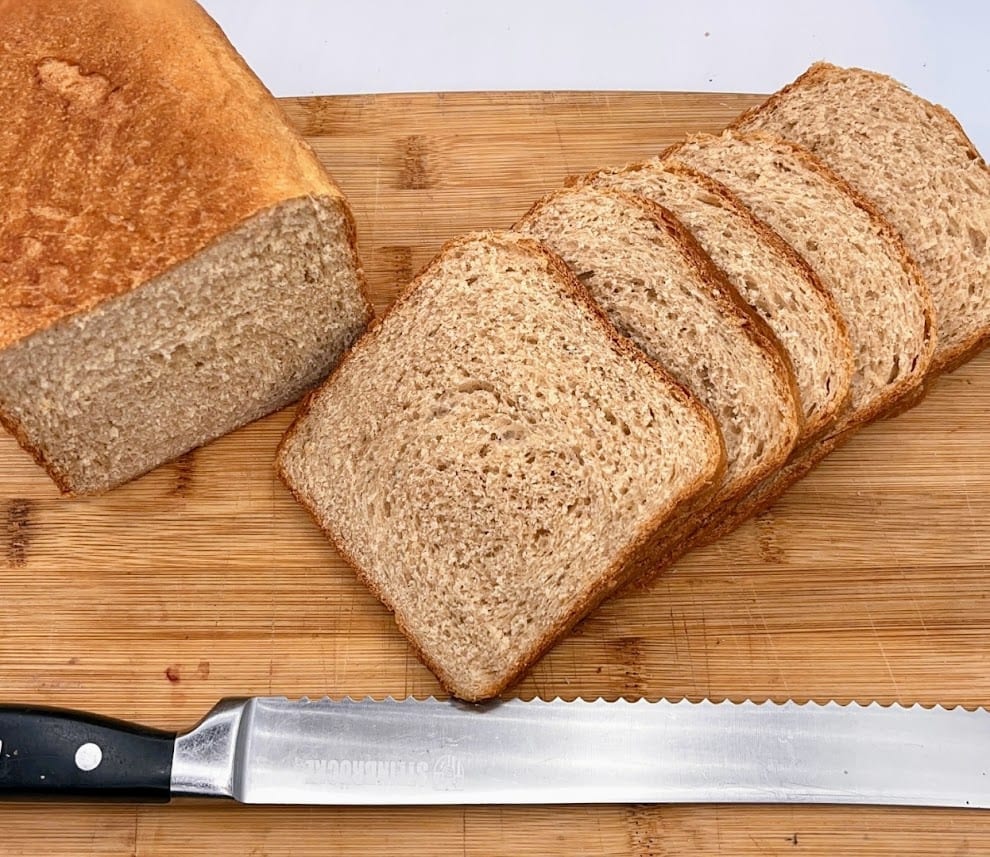
Everyday Multigrain Sandwich Bread
Two Soft Loaves Built on a Seven Grain Soaker
YieldTwo 9 by 5 inch loaves, about 16 slices each
Prep40 minutes
Bake35 to 40 minutes
Difficultybeginner
Ingredients
The Soaker (Night Before, or 1 Hour Ahead)
- 150g seven grain hot cereal, uncooked • ¾ cup plus 2 tablespoons
- 300g boiling water • 1⅓ cups
- 3g fine sea salt • ½ teaspoon
The Dough
- 600g bread flour • 5 cups
- 200g white whole wheat flour • 1¾ cups
- 480g whole milk, lukewarm (about 95F / 35C) • 2 cups
- 80g honey • ¼ cup
- 50g unsalted butter, softened • 3½ tablespoons
- 14g fine sea salt • 2¼ teaspoons
- 8g instant yeast • 2½ teaspoons
The Top
- 15g whole milk, for brushing • 1 tablespoon
- 15g old-fashioned rolled oats • 3 tablespoons
Method
- Put the cereal and salt in a medium heatproof bowl. Pour the boiling water straight over the top and stir it well with a fork or a dough whisk until there are no dry pockets hiding at the bottom.
- Cover the bowl and leave it on the counter. Overnight is best, 8 to 12 hours. One hour is the minimum if you're baking today. When it's ready it looks like thick, cooled porridge and holds its shape on a spoon.
- In the mixer bowl, add both flours, the lukewarm milk, honey, salt, yeast, and the whole soaker. Mix on low with the dough hook for 2 minutes, just until there's no dry flour left. It looks rough and shaggy at this point. That's correct.
- Turn the mixer off, cover the bowl, and walk away for 20 minutes. This short autolyse lets the whole wheat bran soften and the flour finish drinking. The dough will be noticeably smoother when you come back, and you'll knead less for it.
- Add the softened butter in three or four pieces with the mixer on low. It'll look like the dough is coming apart. Keep going. It pulls back together within a minute or two.
- Mix on medium-low for 7 to 9 minutes. You're looking for a dough that clears the sides of the bowl and pulls away from your fingers, soft but not sticky. Check the windowpane-test: stretch a piece thin enough to see light through it. With grain in the dough you'll see the seeds and bits interrupt the window. Look at the film between them, not the bits.
- Mix with a dough whisk until shaggy, rest 20 minutes, work the butter in with your fingers, then slap-and-fold on the counter for 8 to 10 minutes with two rests of 5 minutes in the middle. The rests do half the work for you.
- Shape the dough into a loose ball, drop it into a lightly oiled bowl, and cover it.
- Let it rise at room temperature for 1½ to 2 hours, until it's grown by about three quarters and springs back slowly when you press it. Judge the dough, not the clock. A cold kitchen adds 30 to 45 minutes.
- Turn the dough out onto a lightly floured counter and divide it in two equal pieces. Weigh them. Each should land around 940g. Eyeballing it gives you one tall loaf and one short one every time.
- Pat each piece into a rectangle about 8 inches wide and as long as your pan. Roll it up tightly from the short edge, pinching the seam closed as you go. Push out any big air pockets you feel under your palms.
- Set each loaf seam side down in a greased 9 by 5 inch pan. Press the dough gently into the corners so it fills the pan evenly.
- Cover loosely and proof for 1 to 1¼ hours, until the highest point of the dough sits about 1 inch above the rim of the pan.
- Use the poke-test. Press the side of the loaf gently with a floured finger. The dent should fill back in slowly and not quite all the way. If it springs back fast, give it 15 more minutes. If the dent stays put and the dough sighs, get it in the oven now.
- Brush the tops gently with milk and scatter the rolled oats over them. Brush light. Pressing hard on a fully proofed loaf deflates it.
- Bake at 350F (175C) on the lower-middle rack for 35 to 40 minutes. Rotate the pans front to back at the 20 minute mark if your oven runs hot on one side.
- If the tops are deep brown before 25 minutes, lay a sheet of foil loosely over them and keep baking. Color on top doesn't mean done in the middle.
- Done is 195F to 200F (90C to 93C) in the center. This is the one place I won't tell you to trust your eyes. A grain loaf can look finished and still be wet at the core.
- Turn the loaves out of the pans right away onto a wire rack. Let them cool at least 2 hours before you slice. Cutting warm multigrain bread gives you a gummy, compressed crumb and it's the number one reason people think they failed.