How to Bake a Thanksgiving Bread Cornucopia You Can Eat
Henry Hunter Jr. ·
By Henry Hunter | Crust & Crumb Academy

A Recipe Pantry Holiday Collection recipe
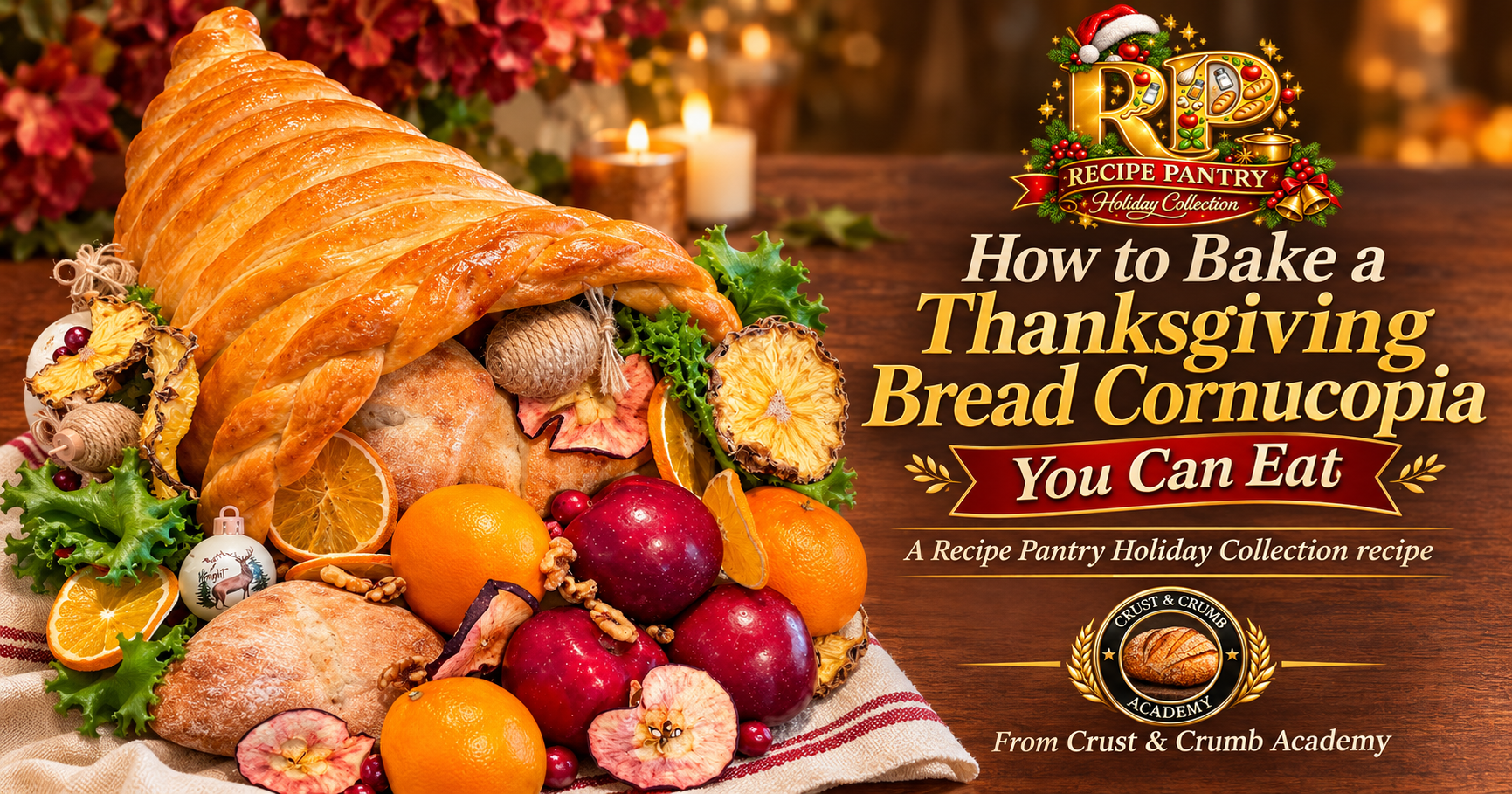
Every year somebody puts a wicker horn on the Thanksgiving table and fills it with gourds nobody eats. This year, bake the horn. It's bread, it holds a pile of rolls and fruit, and when dinner's over you tear into it from the mouth end and work back.
It looks like a showpiece, and it is. But it's built from one firm enriched dough, a foil form you make while the dough rises, ten strips and a braid. If you can roll a rope, you can build this.
Open the full Thanksgiving Bread Cornucopia recipe
Holiday Baking Guide: recipes to make the season delicious

The cornucopia is one piece of something bigger. From festive breads and holiday favorites to sweet treats worth sharing, the Holiday Baking Guide pulls together recipes, baking tips and seasonal ideas to help you make something special this year.
Explore the holiday recipes in the Recipe Pantry
What you're signing up for
- Makes: one horn about 14 inches (35 cm) long, serves 10 to 12
- Total time: about 4 hours 35 minutes, 45 minutes of it hands-on
- Dough: 600 g bread flour, 50% water, plus egg and butter, so it behaves like about 57%
- Bake: 350°F (175°C) on a sheet pan, then a short drying bake at 300°F (150°C)
Why the dough is stiff on purpose
This isn't sandwich dough. Firm dough keeps a clean edge on every strip in the oven, and those edges are what give the horn its ridges. Soft dough slumps and bakes up smooth. If yours feels sticky, knead in a tablespoon of flour and keep going. You want smooth, barely tacky dough around 76 to 78°F (24 to 26°C).
Black Friday deal for our bakers
This dough is stiff, and a strong mixer earns its keep on it. The Bosch Universal Plus stand mixer is $100 off, now $399 (regularly $499) for the white model. Use my code ACADEMY26 at checkout for extra savings. Offer ends November 30.

Shop the Bosch Universal Plus deal
NutriMill is a Recipe Pantry partner. If you buy through this link, I may earn a commission at no extra cost to you.
Build the foil form while the dough rises
The form decides the shape, so give it five minutes of real attention. Here's the target before you tear any foil.
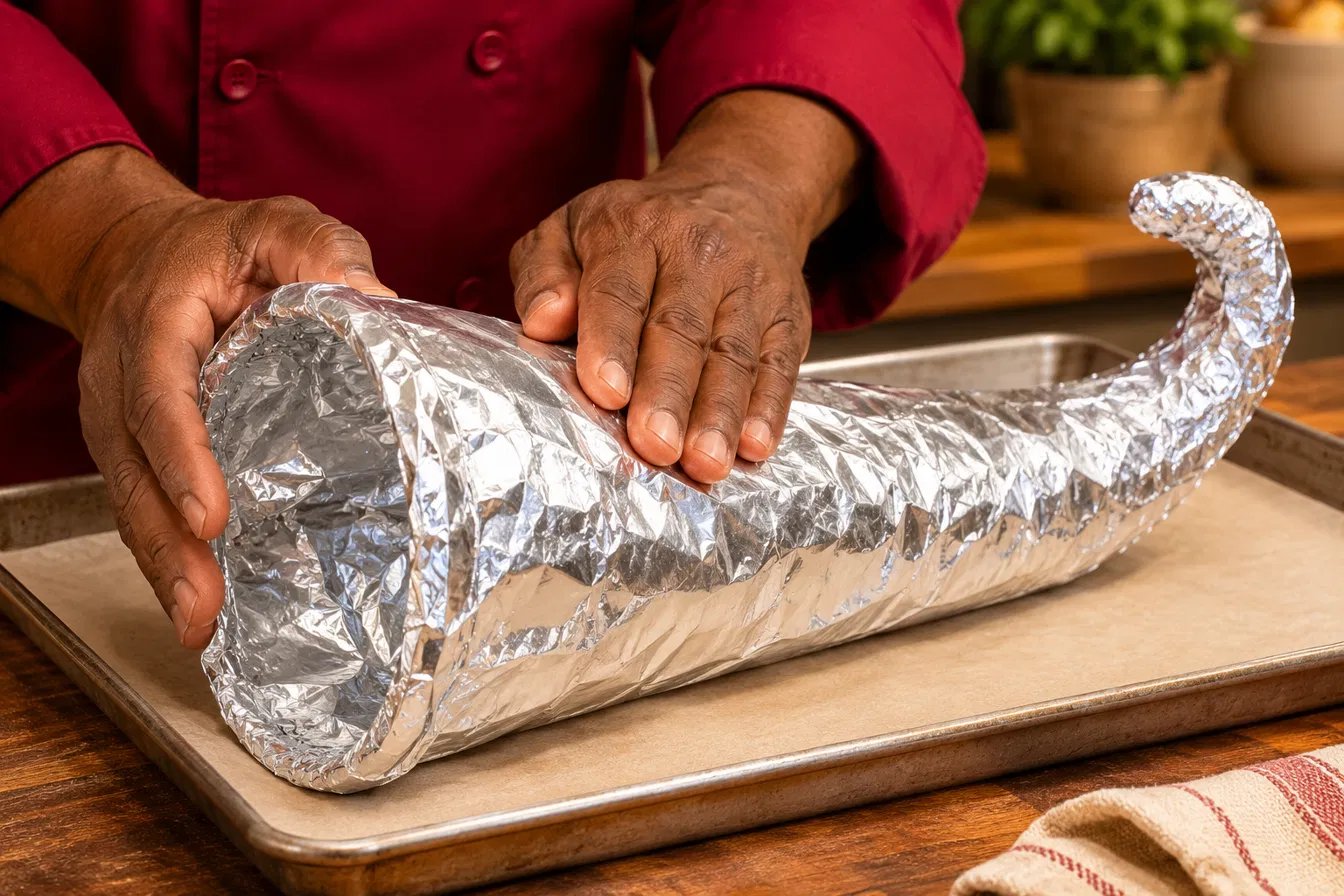
- Roll about 30 inches (75 cm) of heavy-duty foil into a cone 14 inches (35 cm) long with a 6 inch (15 cm) mouth. Fold the mouth edge in to stiffen it.
- Pack it with loose foil balls so it won't sag. Loose, not a solid brick. You have to pull them out later.
- Curl the last 4 inches (10 cm) of the tip up and off to one side.
- Wrap the whole thing in one fresh, smooth sheet of foil. Wrinkles grab dough. Smooth foil lets go.
- Flatten one side so it sits on the pan, check that it fits corner to corner, and oil it everywhere, right down into the curl.
Cut, wrap and braid
Hold back 240 g of dough for the braid. Split the rest into two 400 g pieces, rest them 10 minutes, then roll each to 15 x 7.5 inches (38 x 19 cm) and cut five strips 1.5 inches (4 cm) wide. That's ten strips.
Start at the tip and wind toward the mouth, overlapping each pass by 1/2 inch (1.25 cm). Lay the strips on relaxed. Stretch them and they'll tear in the oven. Pinch new strips on underneath where the seam won't show.
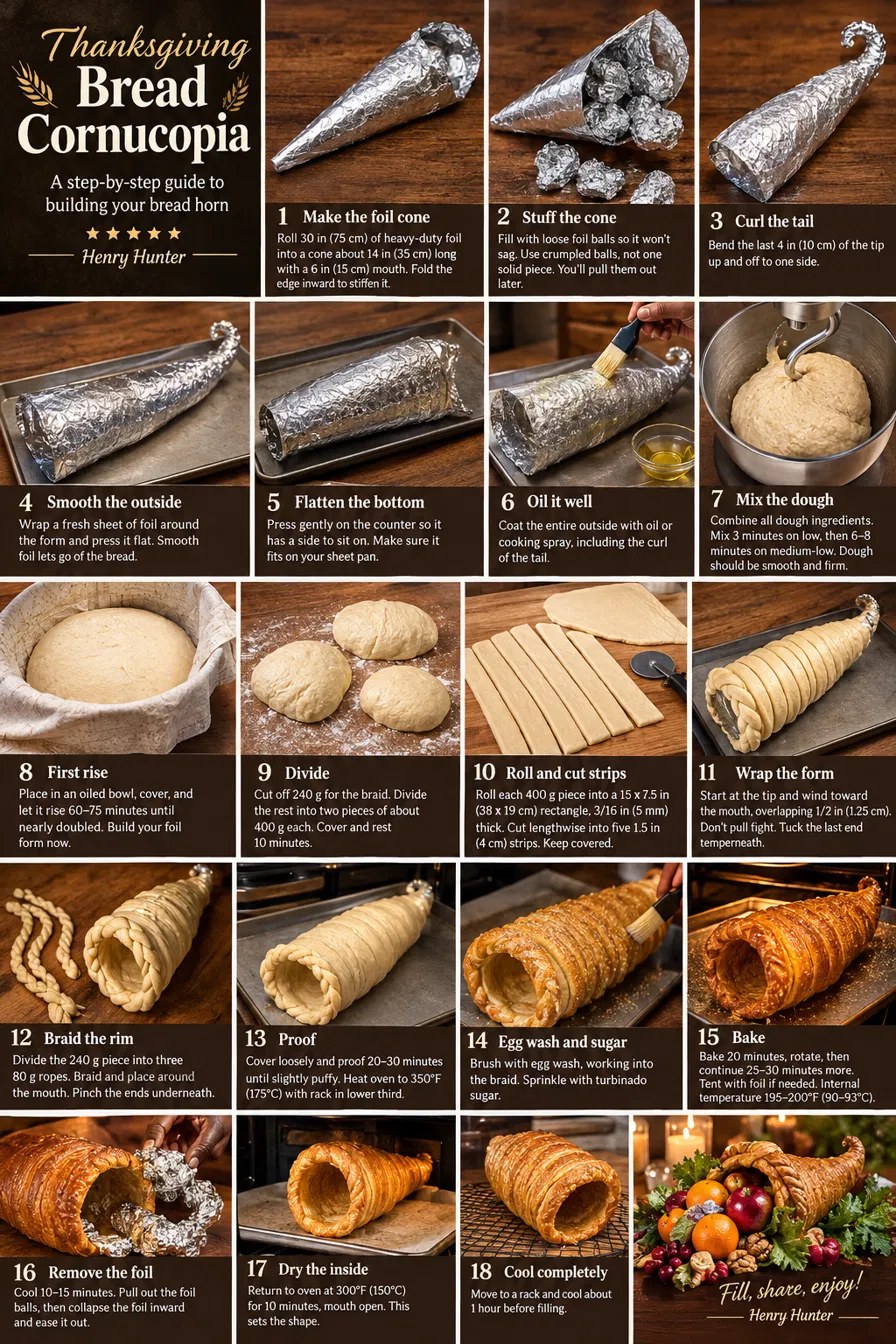
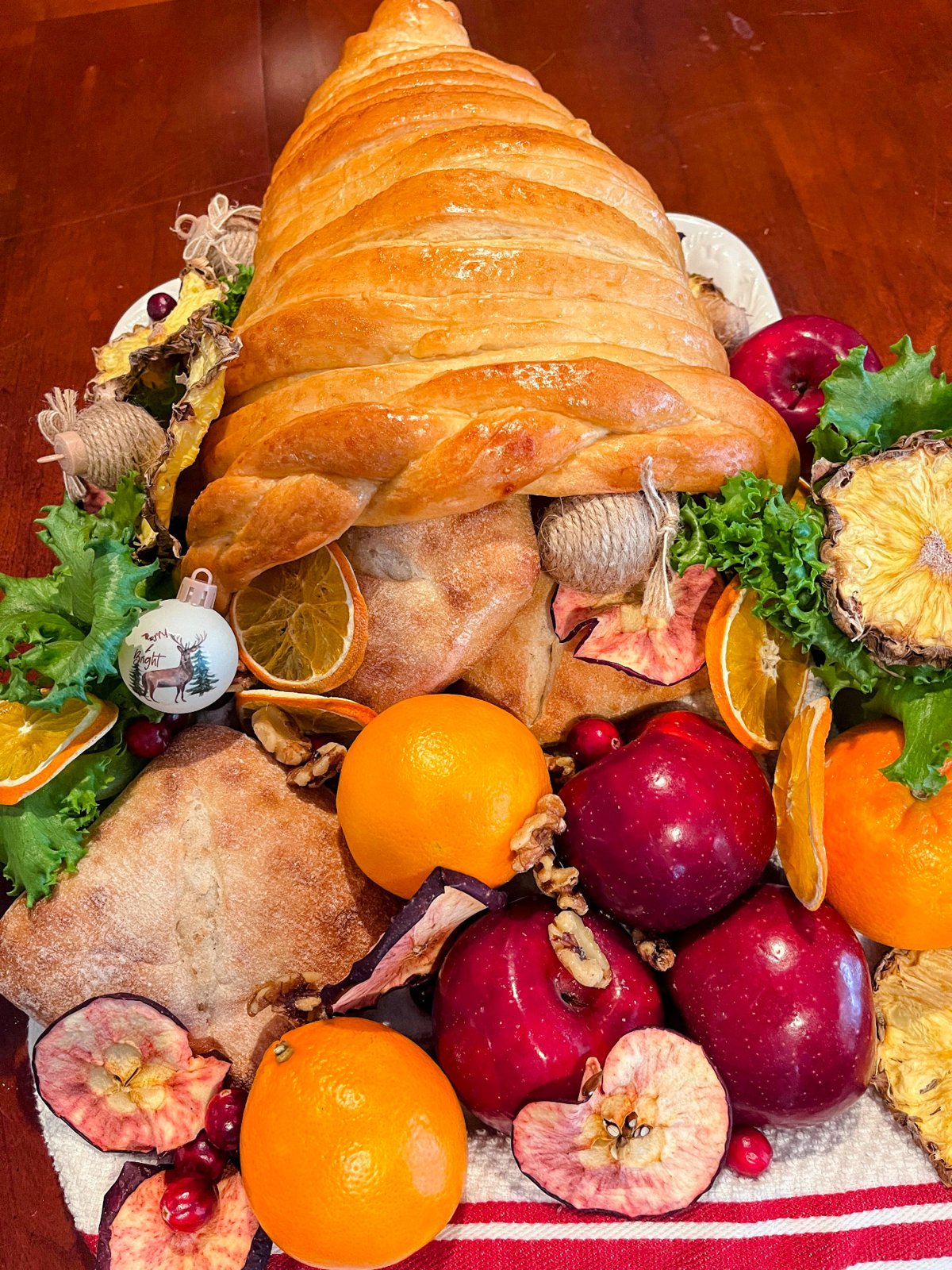
For the rim, roll the 240 g piece into three 80 g ropes, 26 inches (66 cm) long, and braid them. Brush a little egg wash on the last strip, lay the braid around the mouth, and pinch the ends underneath. Here's how it sits on my own horn.
Proof short, bake to temperature
Give it only 20 to 30 minutes, until the strips look slightly puffy. Not doubled. Over-proofing is the other way to lose your ridges. Egg wash the whole surface, work it into the braid without pooling at the base, and sprinkle with turbinado sugar.
Bake at 350°F (175°C), rotate at 20 minutes, and tent with foil once the color is deep golden. Keep going until the thickest part of the braid reads 195 to 200°F (90 to 93°C), usually 45 to 50 minutes. Color will fool you here, since egg wash and sugar brown early. Trust the thermometer.
Cool 10 to 15 minutes, then pull the foil balls out while it's still warm, fold the foil in on itself and ease it out. Go slow at the tail. Put the hollow horn back in at 300°F (150°C) for 10 minutes, mouth open, to set the inside wall. Then cool about an hour before you fill it.
Plan ahead
Bake it the day before, cover it loosely with a towel, and warm it 5 to 8 minutes at 300°F (150°C) before it hits the table. If it's just for display, a fully dried horn holds for several days. It'll be hard by then, so plan on looking, not eating.
Quick fixes
- Strips tore apart: they were stretched or the overlap was too narrow. Keep them relaxed with a full 1/2 inch overlap.
- Tail browning too fast: cap the tip with a small piece of foil, then tent the whole thing later.
- Foil stuck: pull it warm, stuffing first, so the form has room to collapse.

Something's coming this season. Stay tuned.
Perfection isn't required. A slightly lopsided horn full of warm rolls still steals the table. The full recipe has the ingredient list with grams and cups, timers for every rise, and a printable one-sheet for the kitchen.